

Good morning and Happy Monday! I hope those of you who celebrate had a restful and relaxing holiday, and that those of you who don’t had some well-earned time off, anyway. I recently reclaimed my home after hosting for Christmas, and I can’t wait to ring in the new year and say “smell ya later” to 2025. Good riddance.
Over the weekend, I got to watch the Seymour Hersh documentary Cover-Up (Netflix), which I’ve been anxiously awaiting since October. I’ll start by saying that I thought the doc was very good, especially if you’re a journalism nerd who has spent much of your life trying to figure out how reporters like Hersh get so many people with access to talk to them. The film does a deep dive into how Hersh’s biggest stories were broken, including the My Lai massacre and Abu Ghraib stories. As my journalism professors loved to remind us, there’s a lot to be said for just showing up and asking people to talk to you. I will never cease to be amazed by how many people are desperate to unburden their guilty consciences.
But one of the biggest takeaways (for me, anyway) from the film is that legacy media has always been in bed with the US government and corporate America. To me, it has always seemed that there was a golden era of “pure journalism,” where reporters and editors were solid, middle-class jobs and everyone had the resources they needed to do their work. Like everything else for Gen X, that time period, in my brain, has always ended sometime in the 1990s — just before we all hit the workforce. After all, most of the “big” news stories we learned about in J-School — Watergate, the Pentagon Papers, My Lai, Vietnam — all of those stories broke long before my time.
But Cover-Up makes it clear that these stories succeeded despite the people in charge, not because of them. Hersh quit more than one legacy outlet because they wouldn’t publish or wanted to “soften” one of his pieces to keep the powers that be happy. Hersh himself describes how he leaned on 60 Minutes, long considered the gold standard of investigative reporting, to get them to go public with their Abu Ghraib story. Of course, this doc hits Netflix less than two weeks after Bari Weiss spiked a 60 Minutes piece on CECOT, the El Salvador jungle prison where Kristi Noem and DHS shipped undocumented immigrants before the courts got involved. The more things change, the more they stay the same, amirite? (By the way, if you haven’t seen the 60 Minutes segment in question, you can watch it here.)
More than anything else, though, I identified deeply with Hersh’s rage against the world we live in, where human life is so cheap, particularly so if that life exists outside the borders of the United States. At times, Hersh is so outraged by the apathy toward violence and death that he’s nearly brought to tears. Anyone who has howled “CARE MORE!!!” into the void of social media over the course of the last 10 years can certainly relate. There is just so much cruelty, and we’re all so powerless to stop it.
If you’re interested in how reporters get and break stories that change the world, I can’t recommend Cover-Up enough. However, some of it is difficult to listen to, with descriptions of sexual assault, extreme violence, and violence against children sprinkled throughout the film. Even 50 years after My Lai and 20 years after Abu Ghraib, it’s hard to hear the details. So check your trigger warnings going in.
We’re going to keep the news load light here until after the New Year, but here are a few stories that I wanted to flag for you: The DC pipe-bomber isn’t what MAGA had hoped; Reporter Julie Brown finds herself in the Epstein Files; Did one man solve the Zodiac and Black Dahlia murderers?; and The High Note.
Here we go.
Ope - the DC pipe bomber is not what MAGA was expecting
The first few days after the DC pipe bomber was allegedly caught, Kash Patel, the FBI, and the MAGAsphere were trumpeting his name and pictures from the rooftops. After all the claims by the right that the pipe bombs were an inside job, you could almost see the calculus in their heads: “The suspect is Black. Black = liberal. It was a liberal who placed the pipe bombs!”
Alas, the suspect’s motivations aren’t what Patel et al thought they would be, which is probably why they’ve stopped talking about it.
A Virginia man arrested earlier this month repeatedly cited conspiracy theories about the 2020 election when he confessed to placing pipe bombs outside the headquarters of the Democratic and Republican National Committees on Jan. 6, 2021, according to a Department of Justice filing.
The Justice Department had not previously detailed a motive for the attempted attack or any possible connection between the pipe bombs and the Jan. 6 Capitol insurrection. But in a Sunday filing — ahead of his detention hearing, scheduled for Tuesday — the DOJ said suspect Brian Cole Jr. told investigators he “was going to a protest in support of [then President] Trump” on the day of the attack.
According to the document, Cole told investigators: “If people feel that their votes are like just being thrown away, then … at the very least someone should address it.”
Specifically, this is what the suspect told the FBI, per DOJ filings:
Later in the interview, the defendant explained that after the 2020 election, “when it first seemed like something was wrong” and “stuff started happening,” he began following the issue closely on YouTube and Reddit and felt “bewildered.”
As it turns out, the pipe bomber seems to have been radicalized by Trump’s Big Lie that the 2020 election was stolen. How awkward.
Reporter Julie Brown finds herself in the Epstein Files
Miami Herald reporter Julie Brown was one of the first to start covering the allegations against Jeffrey Epstein back in 2018. Since then, she’s written a book on Epstein, and has continued to do award-winning work for The Herald.
But in digging through the most recent batch of released Epstein files, Brown was shocked to find information about herself included.

Julie isn’t as active on Bluesky as she is on Twitter, but I’m interested to hear if she gets an explanation for this. I’ll keep an eye on it, because WTF?
Did this guy solve two legendary cold cases in one fell swoop?
I will admit to being a true crime junkie and, if you are also a true crime junkie, you know that solving the identity of the Zodiac killer is like winning the Super Bowl, World Series, Olympics, and World Cup all rolled up into one. Now that the Golden State Killer has been nabbed (RIP Michelle McNamara), the Zodiac is the granddaddy of cold cases. The Black Dahlia isn’t far behind.
But now, one man is claiming he’s solved both murders, and that the same man is responsible for the death of Elizabeth Short (The Black Dahlia) and the Zodiac murders. I don’t have an LA Times subscription anymore, but this article is available via Apple News, if you use it.
Alex Baber, a 50-year-old West Virginia man who dropped out of high school and taught himself codebreaking, now says he has cracked the Zodiac killer's identity — and in the process solved the Black Dahlia case as well.
***
“I started running variables based on letter-frequency analysis,” Baber said. “It’s my autism. Once I start on something, I have to see it through. The deeper I go, the harder I push. My mind’s wired differently.”
Okay, but so many people have claimed to have solved one or the other of these mysteries in recent years. Why is this claim any different?
Who was Marvin Merrill? It was the alias Marvin Margolis adopted after Short’s murder. It was the name he lived under until his death by cancer in Santa Barbara in July 1993, age 68 (though his gravestone at Riverside National Cemetery bears the Margolis name).
What does it mean? It may take time for anything like expert consensus to emerge. But according to two veteran homicide detectives who once served at the LAPD — including the former cold case detective who oversaw the Elizabeth Short investigation — Margolis is probably responsible for both the Short murder and the five murders attributed to the Zodiac.
They say Margolis left a complex lattice of hidden clues connecting both cases. Among the links, they contend, is his eerie 1992 sketch of a woman that carries the name “ELIZABETH” in plain writing and the name “ZODIAC” hidden in the shading, but visible with the aid of filters.
“In my opinion, these are solved cases,” said Rick Jackson, who was a homicide detective for 36 years, both at the LAPD and at the San Mateo County sheriff’s office. “There are too many links with both. There’s overwhelming circumstantial evidence. He’s left breadcrumbs all along.”
That actually has my attention, because cops typically scoff at any claim to have solved an iconic cold case. Anyway, the whole thing is wild. Marvin Margolis? Never heard of the guy, and I’ve heard of all the guys suspected, believe me. Margolis was a premed student at USC during the time of Elizabeth Short’s murder. Oh, and he also lived with her for 12 days in the months before her death. There’s a lot more to the story, though I’m not sure there’s enough to quiet the doubters. Anyway, interesting stuff. If you want to read the whole thing, shoot me a note and I’ll try to get it to you.
The High Note
Each Day, I do my best to leave you with a smile on your face, a song in your heart, and the will to fight another day.
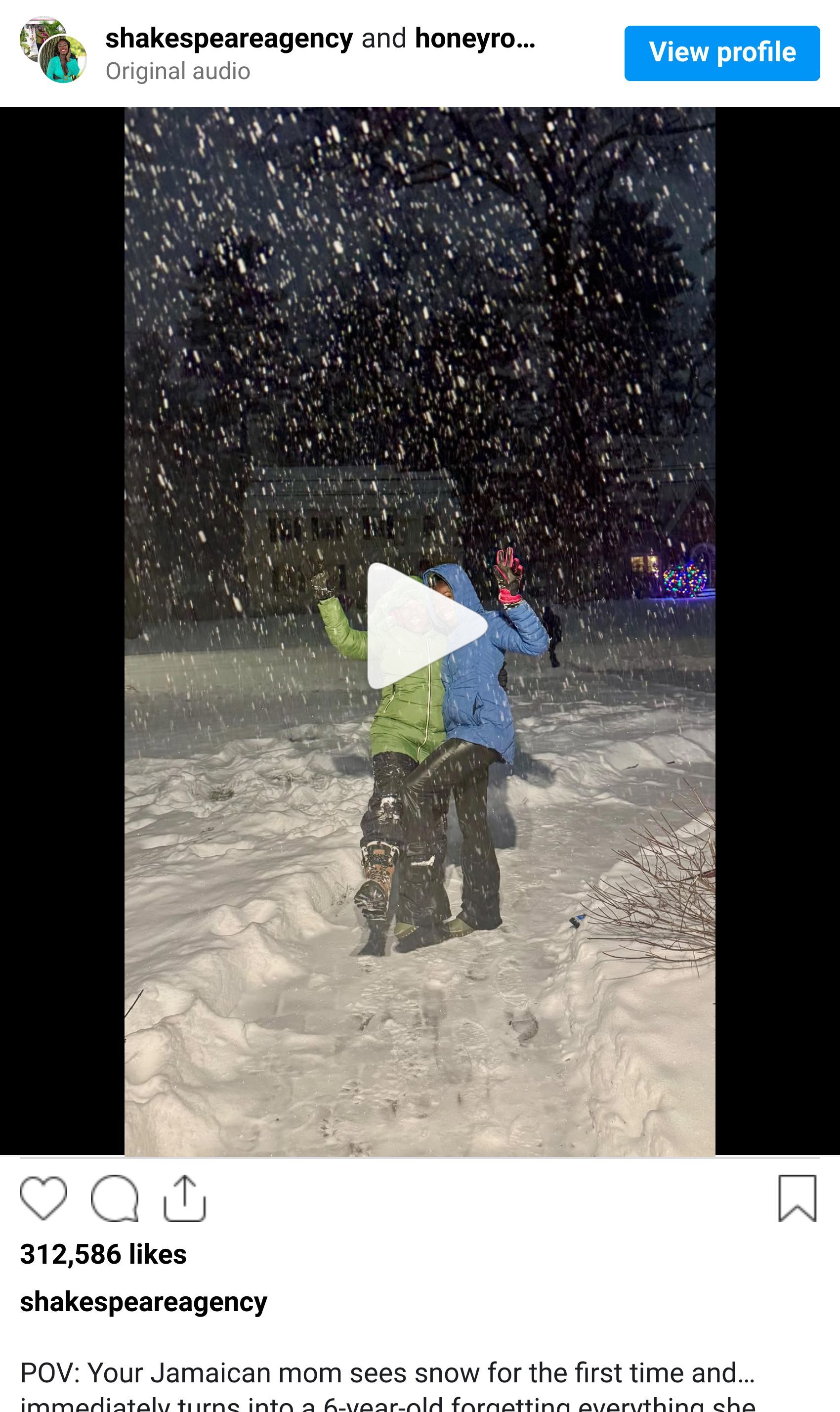
I came upon this video of a Jamaican mom experiencing snow for the first time. Such joy!
Hey, survive and advance out there today, kids. Don’t let the bastards get you down.
